
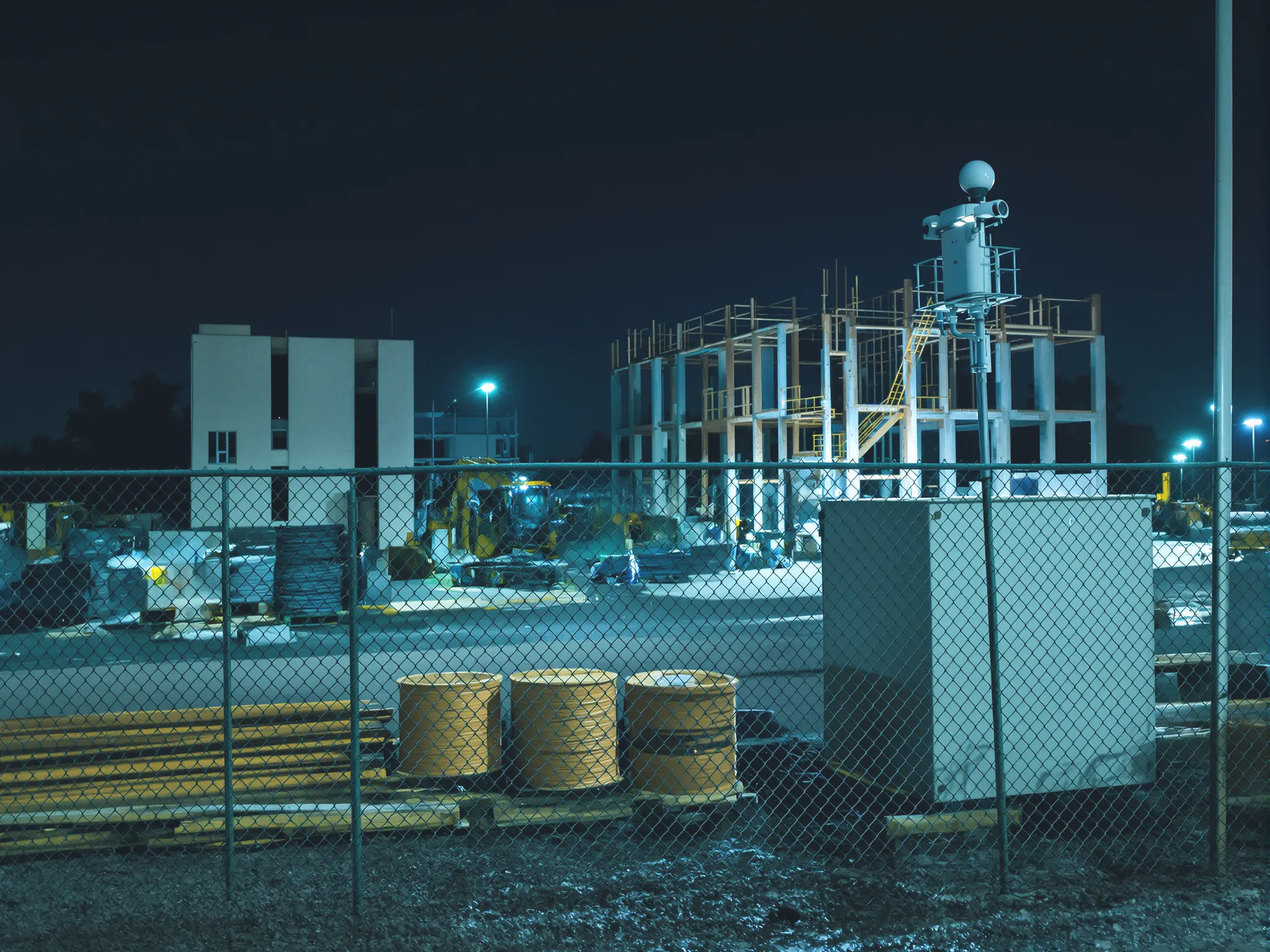
Copper and wire theft in Washington.
What state law says about stolen copper, wire, and catalytic converters, what it means for a job site, and what to do the morning you find it gone.
What does Washington law say about copper and wire theft?
Washington grades metal theft by what it costs the owner, not what the scrap is worth: when the damage to the owner's property is over $750 it is a class C felony, and over $5,000 a class B felony. Unused copper pipe, tubing, and wiring on a job site counts as commercial metal property, which a scrap dealer may buy only from someone with a commercial account, proof of ownership, or authorization to sell. Report a theft quickly: written police notice makes a dealer hold the metal for up to ten business days.
Seen while it's happening, not the next morning
Wire theft is usually found the morning after, in the quiet corners of a site. 911 Sentinel cameras flag a person on the site at night, an alert reaches our team within 30 seconds, and an operator warns them off through the camera within 3 minutes, then calls your team and the police. The video, kept 90 days, gives police the times and descriptions they ask for. Camera monitoring starts at $900 a month.
How often it happens here
The King County Sheriff's Office handled 241 copper wire theft cases in 2025, KIRO 7 reported in March 2026, and a sergeant said it was "happening almost every day of the week." Seattle City Light told its review panel in September 2025 that about 71 of the more than 200 streetlights on the high-rise sections of the West Seattle Bridge were out because of wire theft.
City Light describes the method plainly: thieves open the underground handholes, cut the wire, pull it out, strip it, and sell the copper to recyclers. It hits "locations with lower public traffic where perpetrators have greater seclusion," and is "typically" discovered after the fact. WSDOT reports copper stolen from state street lights, signals, and storage yards.
How the law grades it
Knowingly trafficking in stolen property is a separate class B felony (RCW 9A.82.050), and tools and vehicles used to steal or traffic commercial metal property can be seized (RCW 19.290.230).
| Cost of the damage to the owner | Crime | Class |
|---|---|---|
| $750 or less | Theft in the third degree (RCW 9A.56.050) | Gross misdemeanor |
| Over $750, up to $5,000 | Theft in the second degree (RCW 9A.56.040) | Class C felony |
| Over $5,000 | Theft in the first degree (RCW 9A.56.030) | Class B felony |
For metal property, the law measures the cost of the damage to the owner's property, not the price the metal fetched as scrap.
What scrap dealers must do
- Commercial metal property, which includes unused copper pipe, tubing, and wiring and any metal marked with a company's name, may be bought only from a seller with a commercial account, written proof of ownership, or authorization from the owner (RCW 19.290.030).
- Every seller of nonferrous metal must show current government-issued photo ID, and no more than $30 may be paid in cash; the rest goes by check mailed no sooner than three days later, or by check or transfer if the dealer captures the ID and a photo or video of the metal (RCW 19.290.030).
- Dealers record each seller's name, address, phone, vehicle plate, and the metal's type and weight, and keep the records five years (RCW 19.290.020).
- After written notice from police that metal was reported stolen, a dealer must hold it intact for up to ten business days (RCW 19.290.060).
- Dealers download scrap metal theft alerts daily and check each customer against a no-buy list of people convicted of theft-related crimes in the past four years (RCW 19.290.220, RCW 19.290.250).
Catalytic converters
- Since April 1, 2025, a detached catalytic converter must be marked with the last eight digits of its vehicle's VIN within 24 hours of removal; unmarked converters can be seized (RCW 9A.82.180).
- Having or selling seven or more unmarked converters is a class C felony; six or fewer is a gross misdemeanor (RCW 9A.82.180).
- Only licensed scrap processors and vehicle wreckers may buy converters, and earlier rules added a $1,000 fine per converter for metal property deception (RCW 9A.56.410).
What to do on your site
- Mark copper, wire, and tools with your company's name: marked metal counts as commercial metal property, so a stranger can't legally sell it.
- Keep photos, receipts, and serial numbers for stored material, so police and dealers can match what's recovered.
- Report a theft to police the day you find it and give them the marks and serial numbers; their written notice is what makes a dealer hold the metal.
- Count the full cost of the damage, not just the wire: the law grades the crime by it.
- If you see a wire theft in progress, call 911, as WSDOT advises.
- VIN-mark the catalytic converters on fleet vehicles parked on site.
Common questions
Is stealing copper wire a felony in Washington?
It can be. If the cost of the damage to the owner's property is over $750, it is theft in the second degree, a class C felony; over $5,000, it is theft in the first degree, a class B felony.
Can a scrap yard buy copper wire from anyone in Washington?
Not if it is commercial metal property, such as unused copper pipe, tubing, or wiring from a job site, or metal marked with a company's name. The seller needs a commercial account with the dealer, written proof of ownership, or authorization from the owner.
What is Washington's catalytic converter law?
Since April 1, 2025, a detached catalytic converter must be marked with the last eight digits of its vehicle's VIN within 24 hours of removal, unmarked converters can be seized, and only licensed scrap processors and vehicle wreckers may buy them.
Sources
Checked .
- RCW 19.290.010, definitions (commercial metal property)
- RCW 19.290.020, transaction records
- RCW 19.290.030, ID, commercial metal, and payment rules
- RCW 19.290.060, holding stolen property
- RCW 19.290.220, scrap metal theft alerts
- RCW 19.290.250, no-buy list
- RCW 9A.56.030, theft in the first degree
- RCW 9A.56.040, theft in the second degree
- RCW 9A.82.050, trafficking in stolen property
- RCW 9A.82.180, catalytic converter marking
- Seattle City Light Review Panel, meeting notes, September 17, 2025
- WSDOT, report material theft
- KIRO 7, King County sees major increase in copper wire theft (March 4, 2026)
Get a free site assessment
We reply the same day, walk your property with you, and send a written plan with a firm price after the walk.
Business calls 8am–8pm every day · our monitoring team works around the clock