
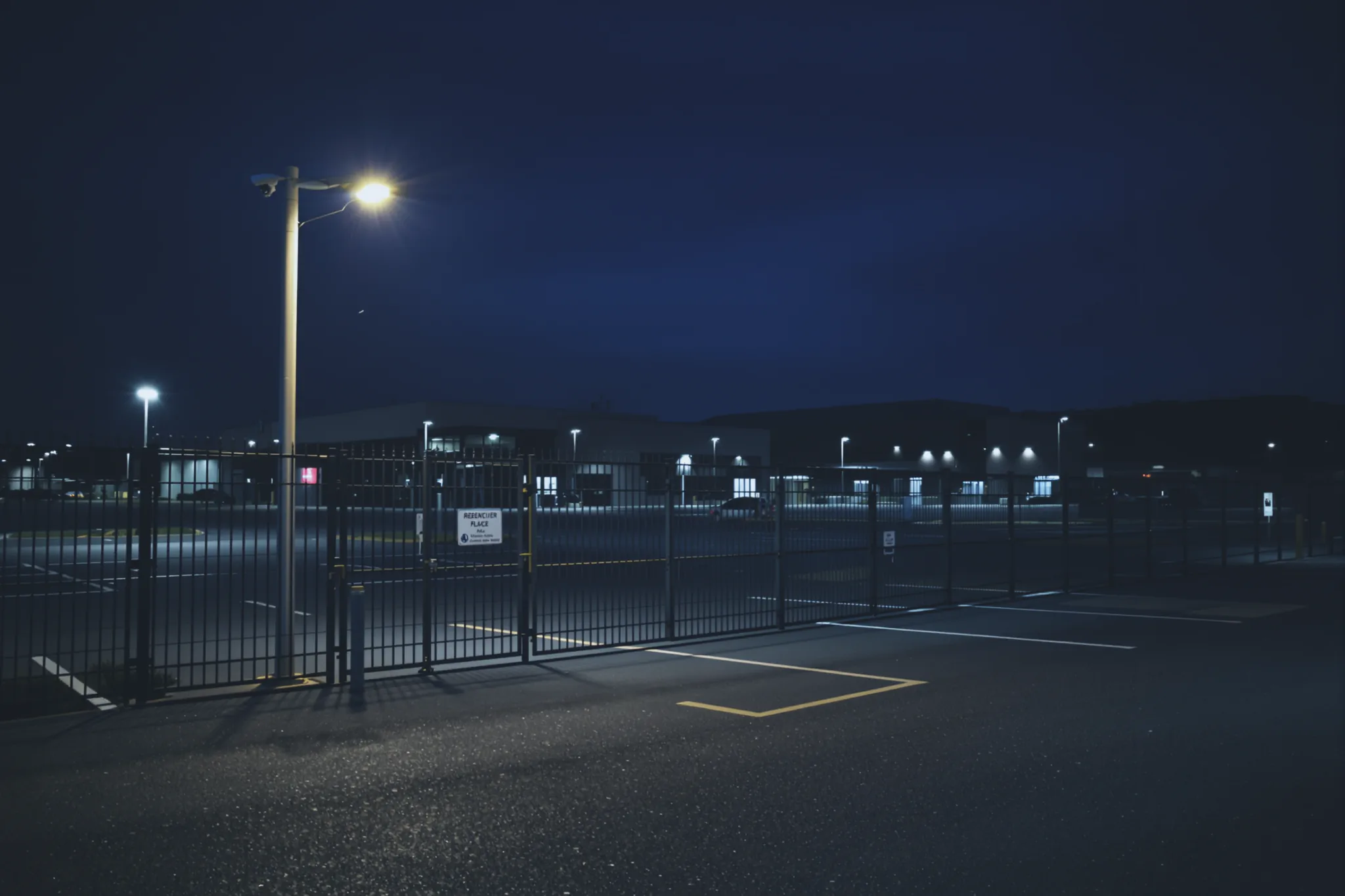
How to stop illegal dumping on commercial property.
Who cleans it up, where to report it in Seattle and King County, what Washington law says about dumping on someone else's land, and how to keep a lot from becoming a dump site.
How do I stop people from illegally dumping on my property?
Block the spots a truck can back into, light them, post no-dumping signs, and clear any pile fast, because one pile invites the next. Then put a monitored camera on the spot that keeps getting hit, so anyone who pulls in hears a recorded warning. In Washington, dumping on land you don't own is illegal, and a court can order the dumper to pay the landowner's cleanup cost.
A warning before the tailgate drops
911 Sentinel puts a monitored camera on the spot that keeps getting hit, from $900 a month with the leased camera, installation, maintenance, and 90 days of video included, and added cameras from $250 a month. When a vehicle pulls in after hours, an alert reaches our team within 30 seconds, and within 3 minutes an operator plays a recorded warning with a siren and spotlights, then calls your team and the police. Every alert is timestamped, so a police report and a cleanup claim have the date, the time, and the video.
Who has to clean it up?
On private property, the owner does. Seattle Public Utilities' illegal dumping program covers public property, such as roadsides, open streets, and paved alleys. King County works the same way: dumping on public property goes to the agency that owns it, and junk on private property is reported to the city, or to King County Local Services outside city limits.
A pile left sitting becomes the owner's problem in Seattle, too. The city doesn't allow junk, including used materials, scrap metal, construction debris, furniture, or trash, to be stored outdoors on private property or the adjacent right of way. The first-time penalty is $150 and $500 for additional violations, higher in certain zones.
What gets dumped and where
| What gets dumped | Where on the property | What helps |
|---|---|---|
| Furniture, TVs, and computers | Beside dumpsters and loading docks | Enclose and lock the dumpsters; a camera on the enclosure |
| Construction debris and yard waste | Back lots, dead-end drives, empty pads | Gate or block drive-in access after hours |
| Tires | Fence lines and lot corners out of sight of the street | Light the corners; a camera on the approach |
| Paint, solvents, and other liquids | Behind buildings and near storm drains | Have a hauler handle it; don't open unknown containers |
| Bagged garbage | Dumpster enclosures and alley edges | Locked lids and gates; clear it within days |
The items Seattle Public Utilities says are reported most: TVs and computers, furniture, paints, solvents and other potentially hazardous liquids, tires, garbage, yard waste, and construction debris.
Make your property a bad place to dump
In 2024 alone, the City of Seattle spent over $1.9 million cleaning up more than 500,000 pounds of dumped waste. Its enforcement cameras play a verbal warning when motion is detected and capture images if the motion continues; the city saw less dumping around the cameras in the pilot's first phase and added four more in Georgetown and South Seattle in 2025.
- Gate or block drive-in access to back lots and empty pads after hours: trucks and trailers need room to back in.
- Light dumpster enclosures, docks, and lot corners.
- Lock dumpster lids and enclosure gates.
- Post no-dumping signs at the spots that get hit.
- Clear dumped material within days. Seattle Public Utilities warns that tolerated dumping "sends a message to violators that it is allowable to dump garbage" there.
- Log every pile with the date, photos, and what removal cost.
Where do you report illegal dumping?
| Situation | Where to report |
|---|---|
| Dumping happening right now | Call 911, King County's advice for a crime in progress |
| Dumped on your property | File a police report with the dates, photos, and video; keep the cleanup receipts |
| On a Seattle street, alley, or roadside | Find It, Fix It app, Seattle Public Utilities' online form, or (206) 684-7587 |
| On public property elsewhere in King County | 206-296-SITE (7483), 1-866-431-7483, or King County's online form |
| Junk stored on someone else's private property in Seattle | SDCI Code Compliance, (206) 615-0808 or its online complaint form |
What does Washington law say about dumping?
- It is illegal to throw, drop, deposit, discard, or otherwise dispose of litter on private property you don't own (RCW 70A.200.060).
- One cubic foot or less is a class 2 civil infraction; more than one cubic foot but less than 10 cubic yards is a misdemeanor; more than 10 cubic yards is a gross misdemeanor.
- A person found liable or guilty also pays a cleanup restitution payment, four times the actual cost of cleanup for a misdemeanor and two times for a gross misdemeanor, and the court gives the landowner an amount equal to the actual cost of cleanup.
- On Seattle's public property, dumping fines start at a $100 base, or $500 with a similar violation in the past 12 months, plus $200 to $1,500 by weight and the cleanup cost. Seattle's investigations need a photo of the vehicle's license plate or other compelling evidence, such as video or an eyewitness (SPU Director's Rule CLN-250).
Common questions
Who is responsible for illegal dumping on private property in Seattle?
The property owner clears it. Seattle Public Utilities' dumping program covers public property such as streets, alleys, and roadsides, and Seattle doesn't allow junk to be stored outdoors on private property, with a $150 first-time penalty and $500 for additional violations.
Is illegal dumping a crime in Washington?
Dumping more than one cubic foot on property you don't own is a misdemeanor in Washington, and more than 10 cubic yards is a gross misdemeanor; one cubic foot or less is a civil infraction. The court also orders a cleanup payment, and the landowner receives an amount equal to the actual cost of cleanup.
How do I stop illegal dumping behind my building?
Gate or block the drive-in access after hours, light the dumpsters and corners, clear piles within days, and put a monitored camera on the spot, so anyone who pulls in hears a recorded warning and the police are called.
Sources
Checked .
- Seattle Public Utilities, illegal dumping
- City of Seattle, Illegal dumping camera pilot expands (August 18, 2025)
- SPU Director's Rule CLN-250, enforcement of illegal dumping violations
- SDCI, junk storage and illegal dumping rules
- King County, illegal dumping
- RCW 70A.200.060, littering prohibited, penalties, cleanup restitution
Get a free site assessment
We reply the same day, walk your property with you, and send a written plan with a firm price after the walk.
Business calls 8am–8pm every day · our monitoring team works around the clock