
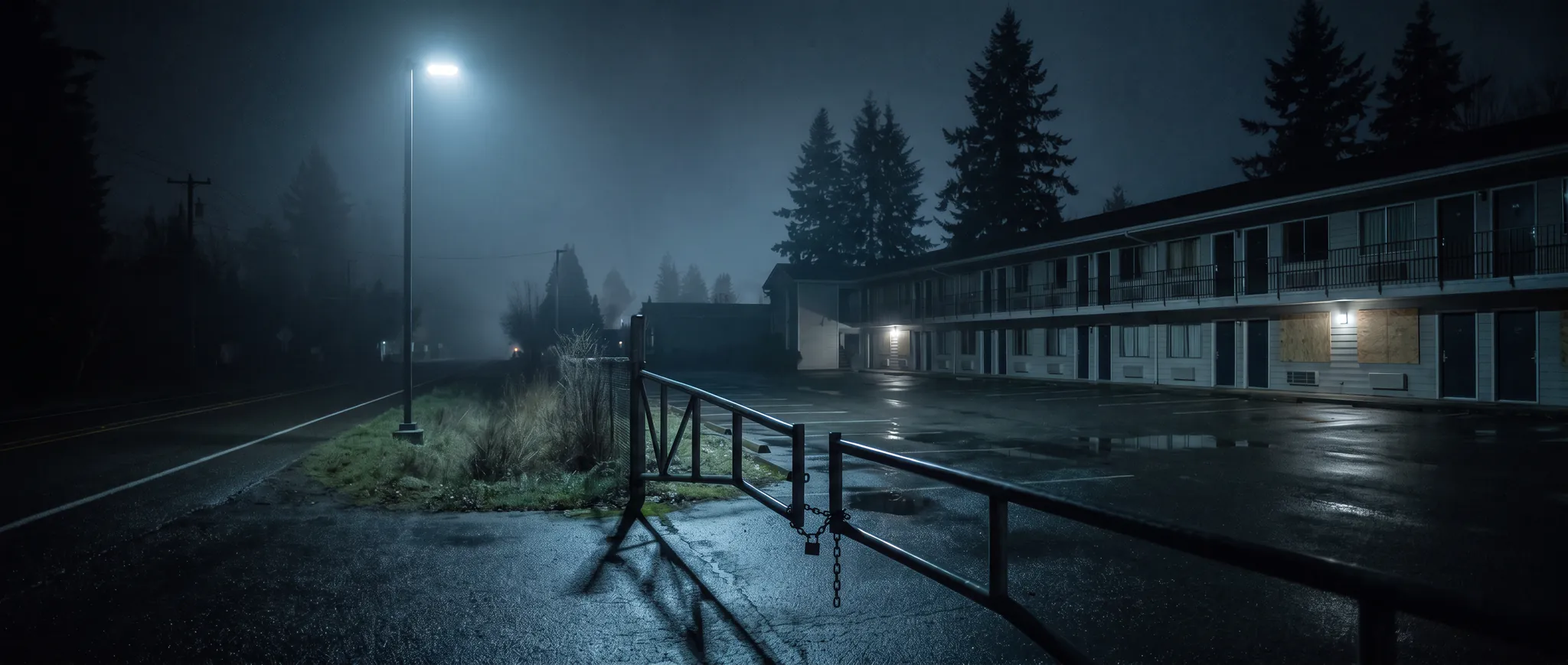
Securing a property in receivership.
What Washington law gives a receiver, what to do the first week after a hotel, motel or building closes, and what its security plan should cover.
How does a receiver secure a closed property in Washington?
Secure it the day operations stop: lock and board every opening, keep power on for the outside lights and cameras, post no-trespassing signs, tell the insurer, and put cameras and patrol passes on the doors, the gate and the perimeter. Washington law gives a receiver the power to pay expenses that preserve the property (RCW 7.60.060), and a timestamped log shows the court what was done.
Watched until the sale closes
911 Sentinel protects hotels, motels and buildings for receivers, lenders and owners while they sit closed. Cameras watch the doors, the gate and the perimeter: an alert reaches our team immediately, and an operator warns the person off through the camera right away, then calls you, and police if you don't pick up. Drive-by vehicle patrol records the gate and the fence line on every pass, and every alert, call and pass goes into the log, with 90 days of video. Coverage starts with a 30-day free trial and runs month to month with one month's notice, so it ends when the property sells. See receivership and closed properties and pricing.
What does Washington law give a receiver?
Washington's receivership statute, RCW 7.60, names two kinds of receiver. A general receiver takes possession and control of all or substantially all of a person's property, with authority to liquidate it. A custodial receiver takes charge of limited or specific property, or has no authority to liquidate. When the only basis for the appointment is a pending foreclosure or a notice of trustee's sale, the court appoints a custodial receiver (RCW 7.60.015).
The statute doesn't spell out how to secure a property. It gives the power to pay for it: RCW 7.60.060 lets a receiver incur or pay expenses incidental to preserving and using the property, and, for an operating business or revenue-producing property, do what the owner could do in the ordinary course. The order appointing you can add powers or limits of its own.
| Section | What it says |
|---|---|
| 7.60.015 | General receiver: all or substantially all of a person's property, with authority to liquidate. Custodial receiver: limited or specific property, or no authority to liquidate. An appointment based only on a foreclosure is custodial. |
| 7.60.025(1)(b) | A receiver can be appointed once a judicial action or nonjudicial proceeding to foreclose on a lien against real or personal property has begun. |
| 7.60.060(1)(a) | The power to incur or pay expenses incidental to preserving and using the property. |
| 7.60.060(1)(b) | For an operating business or revenue-producing property, the power to do what the owner could do in the ordinary course. |
| 7.60.060(2)(c) | The duty to file a certified copy of the appointment order with the auditor of the county where the real property sits. |
| 7.60.100 | A general receiver files a monthly report on operations and finances by the last day of the following month. A custodial receiver reports as the court orders. |
The first week after the doors close
A hotel or motel that closes loses the staff who noticed everything: the front desk, housekeeping and maintenance. The first week sets up what replaces them. Seattle runs a trespass authorization program for commercial property, and Washington's trespass law sets out when someone is on a property unlawfully anywhere in the state.
- Day 1
Lock it, board it, post it
Change or re-key the locks, board broken glass and open units, chain the gate, and post no-trespassing signs at every entrance.
- Day 1
Keep the outside lit
Keep power on for the exterior lights and the cameras. Shut off and drain the water to closed units, so a burst pipe can't flood rooms nobody is checking.
- Days 1-2
Call the insurer
Tell the property insurer the building is closed and ask what its vacancy terms require, including the security it expects.
- Days 2-3
Photograph everything
Walk every unit and the grounds with a camera, so the property's starting condition is on record with dates.
- Days 2-3
Take out what draws people in
Remove or lock up appliances, TVs, linens, tools and anything with copper in it, and move vehicles off the lot.
- Days 3-5
Line up the police
Ask the local police or sheriff how they want trespass on the property reported, and whether they take a written trespass authorization.
- Week 1
Cameras and patrol in place
Cameras on the doors, the office, the gate and the perimeter, patrol passes past the buildings, and a call list with the receiver first.
What should a security plan for a closed property cover?
- Every way in: room doors on outside corridors, the office and lobby, laundry and maintenance rooms, the gate and the fence line.
- The hours it sits empty: a closed property has no staff on any shift, so the monitoring window can run up to 24 hours a day.
- A warning right away: a recorded voice, siren and spotlights the moment someone is seen, not a report the next morning.
- Perimeter passes: a patrol vehicle past the buildings, the gate and the fence line, so an open gate or a cut fence is on video by morning.
- A call list: the receiver or owner first, then police if nobody answers in the agreed time, and 911 right away for a fire.
- A record: a timestamped log of every alert, warning, call and pass, with the video, ready to attach to a report to the court or the lender.
What does security for a closed property cost?
Billed by the hour, camera watching alone adds up fast. On Washington's state security contract, Allied Universal's remote camera monitoring inside Seattle is $48.73 an hour, about $11,860 a month for 8 hours a night, with the cameras not included (what remote video monitoring costs). 911 Sentinel camera monitoring covers the same 8 hours from $900 a month, with one leased camera, installation and maintenance included. Added cameras start at $250 a month, drive-by vehicle patrol starts at $1,500 a month, and windows past 8 hours are priced after the free site walk.
Allied's row is its Seattle rate on Washington's state security contract, cameras not included. Monthly figures are the hourly rate times 8 hours a night, times 365 days, divided by 12, rounded to the nearest $10.
Common questions
What is the difference between a general and a custodial receiver in Washington?
Under RCW 7.60.015, a general receiver takes possession and control of all or substantially all of a person's property with authority to liquidate it. A custodial receiver takes charge of limited or specific property, or has no authority to liquidate. When the only basis for the appointment is a pending foreclosure or a notice of trustee's sale, the court appoints a custodial receiver.
Can a Washington receiver pay for security on the property?
Washington's receivership statute gives a receiver the power to incur or pay expenses incidental to preserving and using the property in the receivership (RCW 7.60.060). The order appointing the receiver can add to or limit that power.
How often does a receiver report to the court in Washington?
A general receiver files a monthly report on operations and finances by the last day of the following month, under RCW 7.60.100. A custodial receiver files reports as the court orders.
What should a receiver do first when a hotel or motel closes?
Lock and board every opening, keep the outside lights and cameras powered, drain the water to closed units, post no-trespassing signs, photograph the property's condition, tell the insurer, and put cameras and patrol passes on the doors, the gate and the perimeter.
How much does security for a closed property cost?
911 Sentinel camera monitoring starts at $900 a month for one leased camera with an 8-hour window, added cameras start at $250 a month, and drive-by vehicle patrol starts at $1,500 a month. Windows up to 24 hours a day are priced after the free site walk, and there are no per-call fees.
Sources
Checked .
- RCW 7.60, receivers (chapter)
- RCW 7.60.015, types of receivers
- RCW 7.60.025, appointment of receivers
- RCW 7.60.060, powers and duties of receivers
- RCW 7.60.100, receiver's reports
- Washington DES statewide contract 00624, Security Guard Services (contract summary)
- Contract 00624 price sheet, effective August 1, 2026, updated September 25, 2026
Get a free site assessment
We reply the same day, walk your property with you, and send a written plan with a firm price after the walk.
Business calls 8am-8pm every day · our monitoring team works around the clock