
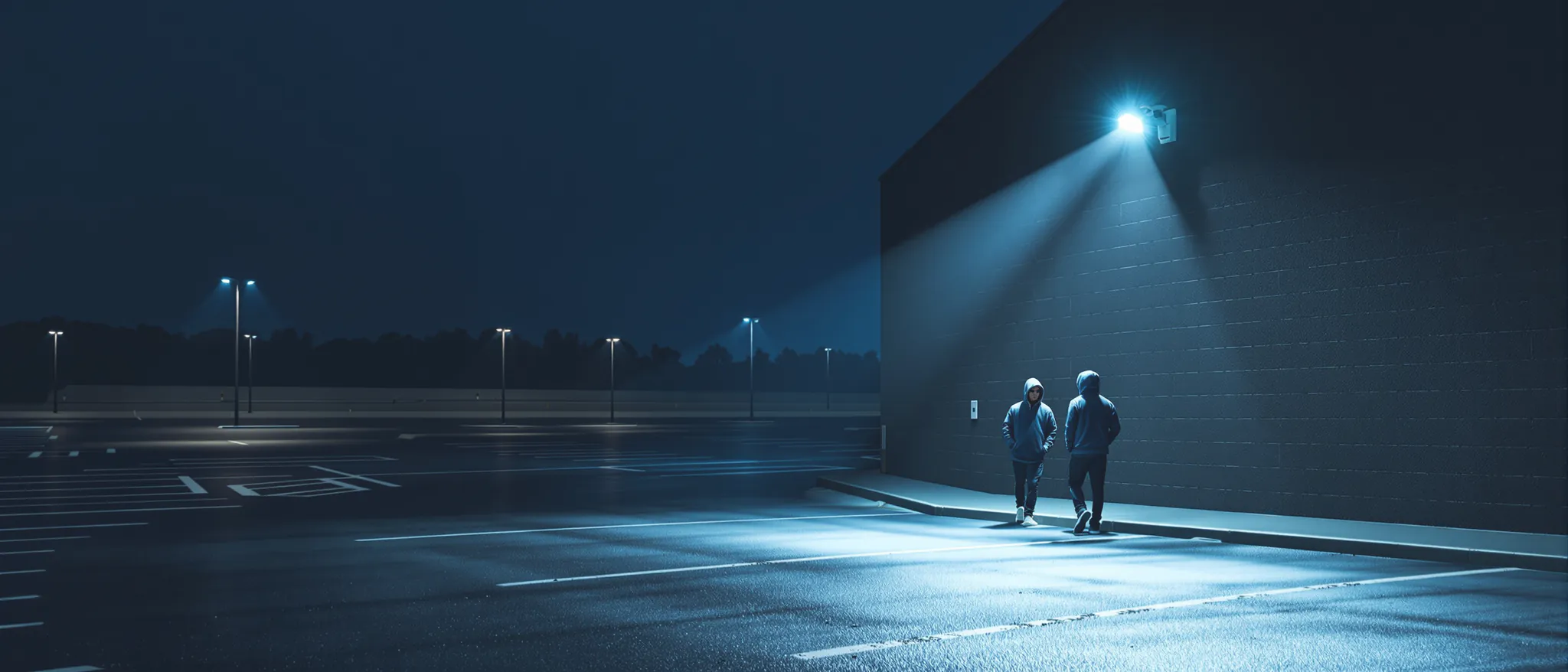
What remote video monitoring is.
Your cameras, watched live, with people who act while it's happening.
What is remote video monitoring?
Remote video monitoring is a service in which a monitoring team watches a property's security cameras live from off site and acts when someone shows up: it warns the person through the camera, calls the owner's contacts and calls police with what the video shows. It is also called live video monitoring, remote guarding or a virtual guard. A camera on its own only records; a monitored camera acts while it is happening.
Remote video monitoring for western Washington
911 Sentinel watches cameras for businesses and job sites from Olympia to Marysville. AI watches every camera, and the moment someone shows up our team warns them off, calls your team, and calls the police if your team doesn't pick up. Camera monitoring starts at $900 a month with one leased camera, installation, maintenance, an 8-hour nightly window and 90 days of video, with added cameras from $250 a month.
Every contract starts with a 30-day free trial, then runs month to month with one month's notice. See why we cost a fraction of hourly monitoring, how our price compares with every published price, and the questions to ask before you sign, each answered for 911 Sentinel.
What else is remote video monitoring called?
Live video monitoring, remote guarding, virtual guard and proactive video monitoring all name the same service. In 2016 UL issued the first certificate for remote guarding under UL 827B, its standard for managed video service providers "that deliver security services by leveraging video cameras and related video technologies installed at protected properties." What UL singles out in the providers it certifies is "active management of security events and subsequent engagement, including handoff and tactical support to law enforcement, all in real time."
How does remote video monitoring work?
This is how 911 Sentinel runs it, on every site where we monitor the cameras:
- Spot
AI flags a person or vehicle
Through the hours you set, AI watches every camera and flags people and vehicles as they appear, dropping duplicates and noise.
- Check
An operator looks at the live picture
What the AI flags goes to our team immediately. The operator compares it with your site rules, so your 6 a.m. crew isn't mistaken for an intruder.
- Warn
A warning plays on site
For someone who shouldn't be there, the operator plays a recorded voice warning through the camera, with a siren and spotlights.
- Call
Your team, then the police
If they stay, we phone the contacts you gave us, then the police if nobody picks up in the time you agreed; in an emergency, 911 straight away. The night ends in an incident report with the video.
How is it different from an alarm, your own cameras or a guard?
Four ways to cover a property at night, by who is watching and what happens when someone shows up:
| Option | Who is watching | When someone shows up | What you have afterwards |
|---|---|---|---|
| Remote video monitoring | A monitoring team, live, through the hours you set | An operator sees them, warns them through the camera, calls your team, then police with what the video shows | Video and an incident report |
| Cameras you watch yourself | You, when a phone notification gets your attention | Whatever you do, if you see the notification in time | A recording, watched after the fact |
| Monitored burglar alarm | A central station receiving door, window and motion signals | The station calls you, then asks police to come, without seeing who is there | An alarm log |
| A guard on site | One person, on the property for the hours you pay for | The guard sees what's in view from where they are and reports it | The guard's report |
Why police treat a video-verified call differently from an alarm
Seattle Police respond to alarm company calls "with evidence of a crime in-progress," such as audio, video or an eyewitness, and not to "sensor or motion activations alone." Live video of someone entering or trying to enter is exactly the evidence SPD names. When our operator calls police (after your team, or right away in an emergency), the call describes what the camera shows as it happens. Seattle's alarm rules and false-alarm fees are in the police guide.
Is a virtual guard the same as a security guard?
No. A virtual guard is a monitoring team watching through cameras; a security guard is a person on the property. Cameras cover the places trouble starts: the gate, the fence line, the loading dock, the back of the building. One team watches every one of them at once, through the whole window. For coverage on the property itself, compare drive-by patrol and a guard on site.
Common questions
Can remote video monitoring use my existing cameras?
Yes. If your cameras give a real-time video feed we can access, we watch them. If they don't, 911 Sentinel installs a leased outdoor camera with a speaker, siren and spotlights, such as the TP-Link Tapo C320WS, the Reolink RLC-811A or the Reolink Duo 3 PoE, and maintains it.
Does remote video monitoring record sound?
911 Sentinel records video only, never sound, and keeps it for 90 days for you. The camera speaker plays recorded warnings; conversations on your property are never recorded.
What happens if the internet goes down?
The site walk checks power and internet before anything is installed: we set up Starlink where a site has no internet, and backup power is an optional add-on. The camera has no battery: without power it stops, and without internet the live view drops until the connection is back.
Do police respond to calls from a video monitoring company?
In Seattle, yes, when the call carries evidence of a crime in progress, such as video of someone breaking in. Seattle Police respond to alarm company calls with audio, video or eyewitness evidence, not to sensor or motion activations alone, and when a 911 Sentinel operator calls police, after your team or right away in an emergency, the call carries what the camera shows.
How is remote video monitoring priced?
By the hour, by the camera, or as a flat monthly or yearly fee per site. Allied Universal's remote camera monitoring on Washington's statewide guard contract is $48.73 an hour inside Seattle, about $11,860 a month for 8 hours a night, cameras not included. 911 Sentinel charges by the month: from $900 with the leased camera, installation, maintenance, an 8-hour nightly window and 90 days of video.
Sources
Checked .
- UL Solutions, UL issues first managed video monitoring services certification (UL 827B), October 4, 2016
- Seattle Police Department, monitored alarms
- Washington DES statewide contract 00624, Security Guard Services (contract summary)
- Contract 00624 price sheet, effective August 1, 2026, updated September 25, 2026
Get a free site assessment
We reply the same day, walk your property with you, and send a written plan with a firm price after the walk.
Business calls 8am-8pm every day · our monitoring team works around the clock