
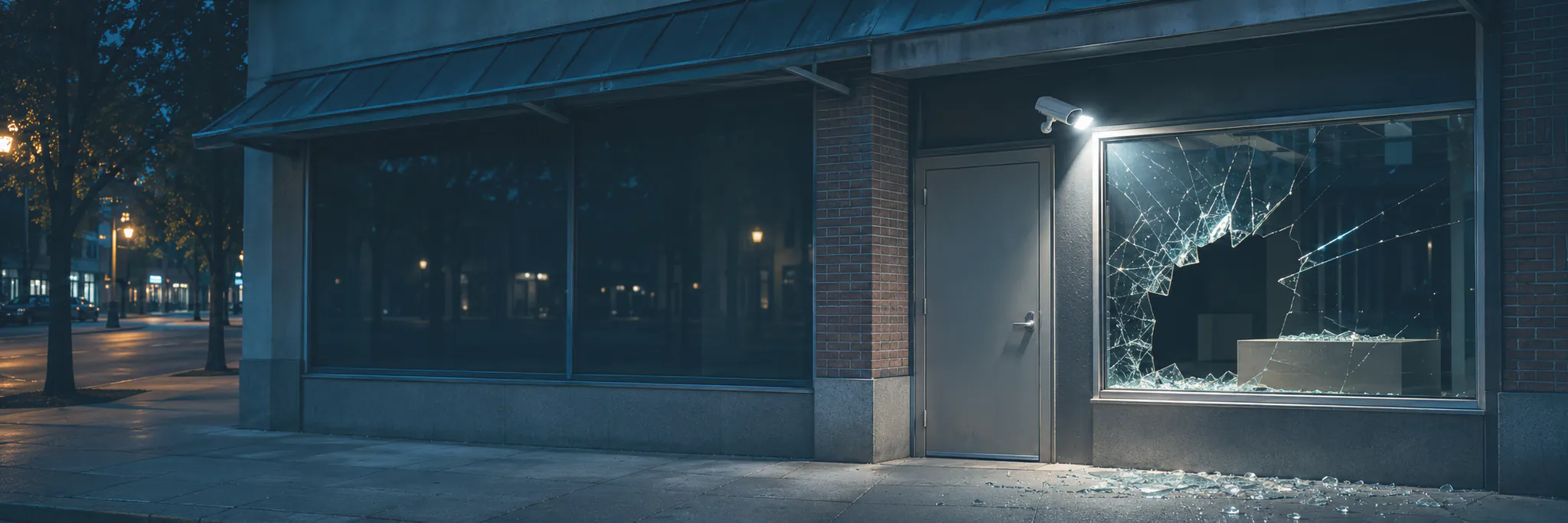
Someone smashed your storefront window.
What Washington law calls a smash-and-grab, what Seattle pays back, which fixes hold up at 3 a.m., and how to keep the next window from going in.
How do I stop thieves smashing my storefront window?
Put someone on the glass the moment it happens, and make the pane hold. A monitored camera warns anyone at the window before they get in, laminated glass or security film keeps a broken pane together, and a gate closes the opening after hours. In Seattle, the Storefront Repair Fund pays back up to $5,000 per incident, three incidents a year.
A storefront that's watched all night
911 Sentinel camera monitoring starts at $900 a month with the leased camera, installation, maintenance, an 8-hour nightly window and 90 days of video included, and added cameras start at $250 a month. An alert reaches our team immediately. An operator checks it against your site rules and plays a recorded warning through the camera with a siren and spotlights. If the person stays, we call your team, then the police if your team doesn't answer in the time you set; in an emergency we call 911 right away.
One camera covers a single storefront; a corner shop or a strip of windows takes more. Retail security shows the full setup, and the pricing lays out every plan. Every contract starts with a 30-day free trial.
Restaurants and cannabis stores face the same front glass: see restaurant and bar security and cannabis store security.
Is a smash-and-grab a burglary in Washington?
Yes, once someone reaches in. RCW 9A.52.030 makes it burglary in the second degree, a class B felony, to enter or remain unlawfully in a building other than a vehicle or a dwelling with intent to commit a crime there. Under RCW 9A.52.010, "enter" includes the insertion of any part of the body, or an instrument held in the hand, so an arm through a broken window counts.
The value of what's taken sets the theft charge on top: under $750 is third-degree theft, $750 to $5,000 second degree, and more than $5,000 first degree. Thieves who hit several stores can face Washington's felony organized retail theft law, which adds thefts together across stores over 180 days.
| Charge | Statute | Threshold | Class |
|---|---|---|---|
| Burglary, second degree | RCW 9A.52.030 | Entering a commercial building unlawfully to commit a crime | Class B felony |
| Theft, first degree | RCW 9A.56.030 | More than $5,000 | Class B felony |
| Theft, second degree | RCW 9A.56.040 | More than $750, up to $5,000 | Class C felony |
| Theft, third degree | RCW 9A.56.050 | $750 or less | Gross misdemeanor |
Why the same storefront gets hit again
Break-ins cluster on the same blocks, year after year. In our repeat-block study, the busiest 10% of Seattle blocks held 56.2% of recorded property offenses, and our hotspot study found 63.4% of top-decile block memberships still elevated 12 months later. A window that went in once sits on a block that is still being worked.
Our Seattle commercial burglary report shows the recorded count week by week, by neighborhood.
- Of Seattle property-offense records on the busiest 10% of blocks (911 Sentinel study, July 2023–June 2026)
- 56.2%
- Of top-decile block memberships still elevated 12 months later (911 Sentinel study)
- 63.4%
- Separate incidents a Seattle shop can claim from the Storefront Repair Fund
- 3 a year
What does Seattle pay back after a smashed window?
Seattle's Storefront Repair Fund reimburses repairs up to $5,000 per incident, for up to three incidents in a calendar year, for damage on or after July 1, 2024. It's a reimbursement: you pay first and send paid invoices or receipts. It's for independently owned shops with no more than five locations and 50 full-time-equivalent employees, and it won't cover damage you claimed on insurance unless that claim was rejected and closed. Applications are open through December 2027 or until funds run out.
The Storefront Security Fund is the upgrade side: up to $10,000 after a free CPTED assessment, for items bought after it. The morning-after steps, from the police report to the insurer, are in what to do after a business break-in.
| Cost | Seattle fund |
|---|---|
| Broken or etched windows, doors, locks, gates, fences, signs | Storefront Repair Fund, up to $5,000 per incident |
| Stolen merchandise | Not covered by the fund |
| Graffiti | Not covered by the fund; see Seattle's graffiti rules |
| Damage already claimed on insurance | Not covered unless the claim was rejected and closed |
| Security film, laminated glass, gates, lighting, cameras | Storefront Security Fund, up to $10,000 after a CPTED assessment |
| Someone watching the cameras | Not covered: both funds pay for equipment, not monitoring services |
Roll-down gates, security film or monitoring: what stops it?
Each fix closes a different gap. Film and gates make the window slower to get through. Monitoring puts a person on the window the moment someone is at it, which is the part the other fixes leave to the morning. The strongest storefronts use the hardware and have it watched.
| Fix | What it does at 3 a.m. | What it leaves to chance |
|---|---|---|
| Security film or laminated glass | Holds the broken pane together so it takes longer to get through | Nobody knows it was hit until morning |
| Scissor or folding gate | Closes the opening after hours | Has to be locked every night |
| Alarm system | Sounds a siren and sends a signal | An unverified alarm is a low police priority; see will police respond to an alarm |
| Monitored camera with speaker and spotlight | A person sees the window, warns them off and calls your team, then police | Nothing waits for morning |
What to do the night it happens
- If someone may still be inside, stay out and call 911.
- Export the video from every camera before it records over.
- Board up, and keep the paid receipt for the Repair Fund.
- Photograph the glass, the frame and the empty display before cleanup.
- Decide between the fund and insurance before filing either.
How monitoring stops the second window
A smash-and-grab is loud and fast, and it starts with someone standing at the glass. Camera monitoring puts our team on that moment instead of the morning after.
- At the window
Our team sees it
AI flags a person at the glass after close, and the alert reaches our team immediately.
- Right away
Warned off
An operator plays a recorded warning with a siren and spotlights on the storefront.
- If they stay
Your team, then police
We call your team, then the police if your team doesn't answer in the time you set, and 911 right away if the glass goes.
- Morning
The record
An incident report with the time and clip, ready for the police, the insurer and the Repair Fund.
Common questions
Is a smash-and-grab a burglary or a theft in Washington?
Usually both. Entering a commercial building unlawfully with intent to commit a crime is burglary in the second degree, a class B felony, and reaching through a broken window counts as entering. The value taken sets the theft charge: $750 or less is a gross misdemeanor, more than $750 a class C felony, and more than $5,000 a class B felony.
Does Seattle pay to fix a smashed store window?
Yes. The Storefront Repair Fund reimburses up to $5,000 per incident, for up to three incidents a calendar year, for damage on or after July 1, 2024. You pay first and send paid receipts. It's for independently owned businesses with no more than five locations, and it won't cover damage claimed on insurance unless that claim was rejected and closed.
Does security film stop smash-and-grab break-ins?
Security film and laminated glass hold a broken pane together, so it takes longer to get through, and Seattle's Storefront Security Fund reimburses both. They slow a break-in down; a monitored camera adds a person who sees the window as it happens, warns them off and calls your team and the police.
What does it cost to have a storefront monitored at night?
911 Sentinel camera monitoring starts at $900 a month with the leased camera, installation, maintenance, an 8-hour nightly window and 90 days of video included. Added cameras start at $250 a month, there are no per-call fees, and every contract starts with a 30-day free trial.
Sources
Checked .
- RCW 9A.52.030, burglary in the second degree
- RCW 9A.52.010, definitions (enter, premises)
- RCW 9A.56.030, theft in the first degree
- RCW 9A.56.040, theft in the second degree
- RCW 9A.56.050, theft in the third degree
- City of Seattle, Storefront Repair Fund (updated November 2026)
- City of Seattle, Storefront Security Fund (updated November 2026)
Get a free site assessment
We reply the same day, walk your property with you, and send a written plan with a firm price after the walk.
Business calls 8am-8pm every day · our monitoring team works around the clock