
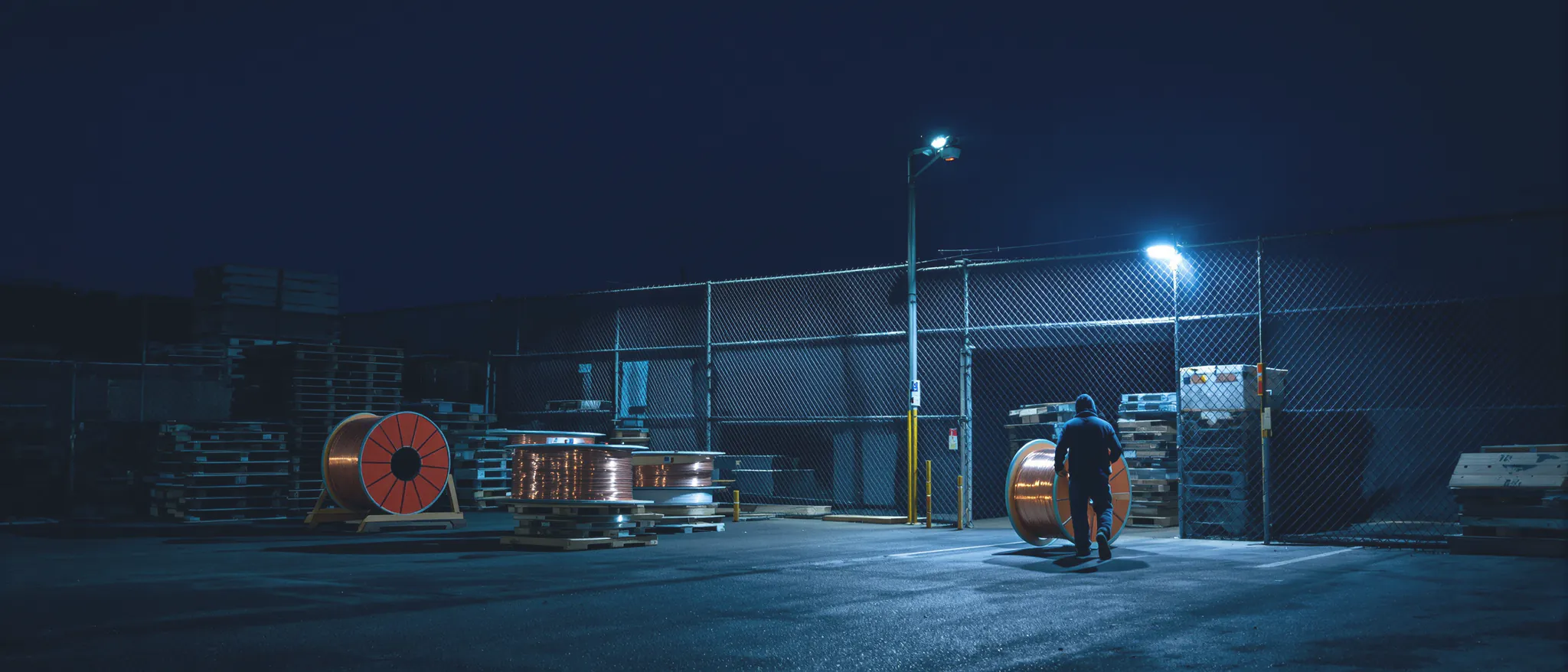
Securing a job site over the holiday shutdown.
A two-week winter break leaves a site empty for 16 days. The 2026 dates, what insurers ask before a shutdown, the fire watch rule for tall and large buildings, and a checklist for western Washington contractors.
How do you secure a construction site over the holiday shutdown?
Treat the holiday shutdown as 16 unwatched days: a crew that leaves Friday, December 18, 2026 is back Monday, January 4, 2027. Lock and clip the fence, remove or lock up tools, copper and fuel, post no-trespassing and camera signs, confirm any fire watch the code requires, and have someone watching the cameras every night of the break.
Watched all 16 nights
911 Sentinel camera monitoring starts at $900 a month with the leased camera, installation, maintenance, an 8-hour nightly window and 90 days of video included, and added cameras from $250 a month. An alert reaches our team within 30 seconds, and within 3 minutes an operator checks it against your site rules and plays a recorded warning through the camera with a siren and spotlights. If the person stays, we call your team, then the police if your team doesn't answer in the time you set; in an emergency we call 911 right away.
For long fence lines, on-site vehicle patrol from $2,200 a month parks our four-camera roof-rig vehicle on the site, and drone surveillance from $6,000 a month sweeps sites too big to wire. One unarmed guard 8 hours a night in Seattle costs about $9,380 a month at the state contract median (what job-site security costs). Every contract starts with a 30-day free trial, then runs month to month with one month's notice. See construction site security in Seattle.
The 2026-27 shutdown calendar
Christmas and New Year's Day both fall on a Friday this season, so the usual two-week break runs from Saturday, December 19 through Sunday, January 3. Anything taken on the first night isn't found until the crew is back.
- Thu Nov 26
Thanksgiving
A four-day weekend, Thursday through Sunday. A good dry run for the shutdown plan.
- Fri Dec 18
Last shift
Walk the site with the checklist below before the gate is locked.
- Sat Dec 19
Day 1: the site is empty
No crew, no deliveries, and fewer neighbors around to notice a truck at the gate.
- Dec 24-25
Christmas
The quietest nights of the break on most sites.
- Fri Jan 1
New Year's Day
Day 14.
- Mon Jan 4
Crew back
The first chance to find a theft from December 19, unless someone was watching.
Does construction theft go up over the holidays?
Not in the national numbers. The most recent equipment theft report from the National Equipment Register and NICB found thefts peak in July and August, when the most equipment is out; December through February are among the quietest months. The shutdown risk is time: the report notes that thefts from work sites "may go unnoticed for a longer period of time," and that "most thefts are from work sites with little or no security." A 16-day gap is the longest a site goes without anyone looking.
Seattle's records show the same effect. In our study of report lag, theft from a building took a median 71.3 hours to reach a police report, against under 4 hours for thefts someone saw. Our construction-theft study found that permit phase alone doesn't predict theft; site conditions and moments like a shutdown matter more.
- Construction and farm equipment thefts reported nationally in the latest NER/NICB report
- 11,574
- Share of that stolen equipment that was recovered
- 21%
- Estimated value stolen, before rental, delay and downtime costs
- ~$300M
- The 2026-27 shutdown with nobody on site
- 16 days
What insurers ask before a shutdown
Builder's risk carriers publish their own shutdown checklists. Liberty Mutual's shutdown planning guide asks, among other things:
- "Are all project access points secured?" and "Is exterior fencing secured and maintained? For example, are fence clips in place and secured?"
- "Does the project location require manned security? If so, consider the frequency of security walks, how security will maintain documentation of inspections/visitors."
- "Are camera systems in place or feasible to install?" and "Do signs warn that camera systems are in place?"
- "Are signs and postings prominently displayed at all potential entry points to warn of hazards and inform of NO TRESPASSING?"
- "Can all ignitible liquids and compressed gas cylinders be removed from the site?" and "Is the building envelope water tight?"
- Travelers adds that "continuously monitored motion-activated detection systems, when installed properly, can help to ward off intruders and prevent losses," and for shutdowns: secure cranes, keep high-value materials out of view, and keep fire detection monitored.
Do you need a fire watch over the shutdown?
On some buildings, yes. Washington's fire code, WAC 51-54A-3303, section 3303.5.1, requires a fire watch during nonworking hours for new construction over 40 feet tall above the lowest adjacent grade, for new multistory construction with more than 50,000 square feet per story, or as the fire code official requires. That includes holidays. The Seattle Fire Code adopts the same rule and adds that guard service or security fences "shall be provided where required by the fire code official."
A code fire watch is people on site making "constant patrols" and keeping a log, and the code says fire watch and site security duties can be combined. Camera monitoring is not a code fire watch; on sites that need one, it watches the perimeter alongside it. Under OSHA 1926.150, extinguishers that could freeze must be protected from freezing, which matters on a site left cold for two weeks.
Christmas shutdown checklist
More detail on each step in the construction site security checklist, stopping copper wire theft and construction equipment theft prevention.
| When | Task | Why |
|---|---|---|
| Two weeks out | Ask your builder's risk carrier what it expects over the break | Some policies set security conditions for unattended sites |
| Two weeks out | Confirm whether the building needs a code fire watch | Required over 40 feet or 50,000 square feet per story in Washington |
| Two weeks out | Line up monitoring that starts before the last shift | So the first night is covered and tested |
| Last week | Return rentals you won't need; register serial numbers of what stays | Fewer machines to lose, and recoverable ones if they go |
| Last week | Lock tools, wire and copper in containers, away from the fence line | Copper and tools are what walks first |
| Last week | Drain or remove fuel and gas cylinders where you can | Fuel theft and fire risk |
| Last shift | Clip and walk the fence, lock every gate, chain the equipment | Access points are the first thing an insurer asks about |
| Last shift | Post no-trespassing and camera signs at every entry | Notice under Washington trespass law and a deterrent |
| Last shift | Check the envelope is watertight and extinguishers are protected from freezing | Two weeks of rain and cold |
| Every night | Someone watching the cameras, with a call list for the break | So a theft on December 19 isn't found on January 4 |
A vacant building on the site
If the project includes an existing building waiting for demolition, Seattle's vacant building standards require it to be secured against entry, and buildings in the city's monitoring program are inspected monthly with fees from $336.82 to $781.84. Trespass inside it goes to Seattle Police. Our vacant building rules guide covers the rest.
Common questions
When is the 2026 construction holiday shutdown?
Christmas and New Year's Day both fall on a Friday, so a two-week shutdown usually runs from Saturday, December 19, 2026 through Sunday, January 3, 2027, with crews back Monday, January 4. That is 16 days with nobody on site. A shorter break from December 24 is 11 days.
Do I need a fire watch during a construction shutdown in Washington?
On larger buildings, yes. Washington's fire code requires a fire watch during nonworking hours for new construction more than 40 feet tall, for new multistory construction over 50,000 square feet per story, or when the fire code official requires one. A fire watch means people on site making constant patrols and keeping a log.
Does construction theft go up over the holidays?
National equipment theft data peaks in July and August, not December. The holiday risk is how long a site sits unwatched: a theft on the first night of a two-week shutdown may not be found until the crew is back, and the national report found most thefts come from work sites with little or no security.
What should a construction site shutdown checklist include?
Ask your insurer what it expects, confirm any required fire watch, lock tools and copper away from the fence, remove fuel and gas cylinders, clip and walk the fence, lock every gate, post no-trespassing and camera signs, make the building watertight, protect extinguishers from freezing, and have someone watching the site every night.
Can I get site monitoring just for the holiday shutdown?
Yes. 911 Sentinel camera monitoring starts at $900 a month with the leased camera, installation, maintenance and 90 days of video included. Every contract starts with a 30-day free trial, then runs month to month with one month's notice, so there is no long term to sign for a two-week break.
Sources
Checked .
- NER and NICB, 2016 Equipment Theft Report
- Liberty Mutual Risk Control, construction site shutdown planning guide (RC 5300)
- Travelers, protecting your construction site from fire, water and theft
- Travelers, temporary job site shutdowns in construction
- WAC 51-54A-3303, Washington fire code, fire safety during construction
- 2021 Seattle Fire Code, chapter 33
- OSHA 29 CFR 1926.150, fire protection (construction)
- Seattle SDCI, vacant building standards
- Washington DES statewide contract 00624, Security Guard Services (contract summary)
- Contract 00624 price sheet, effective August 1, 2026, updated September 25, 2026
Get a free site assessment
We reply the same day, walk your property with you, and send a written plan with a firm price after the walk.
Business calls 8am-8pm every day · our monitoring team works around the clock