
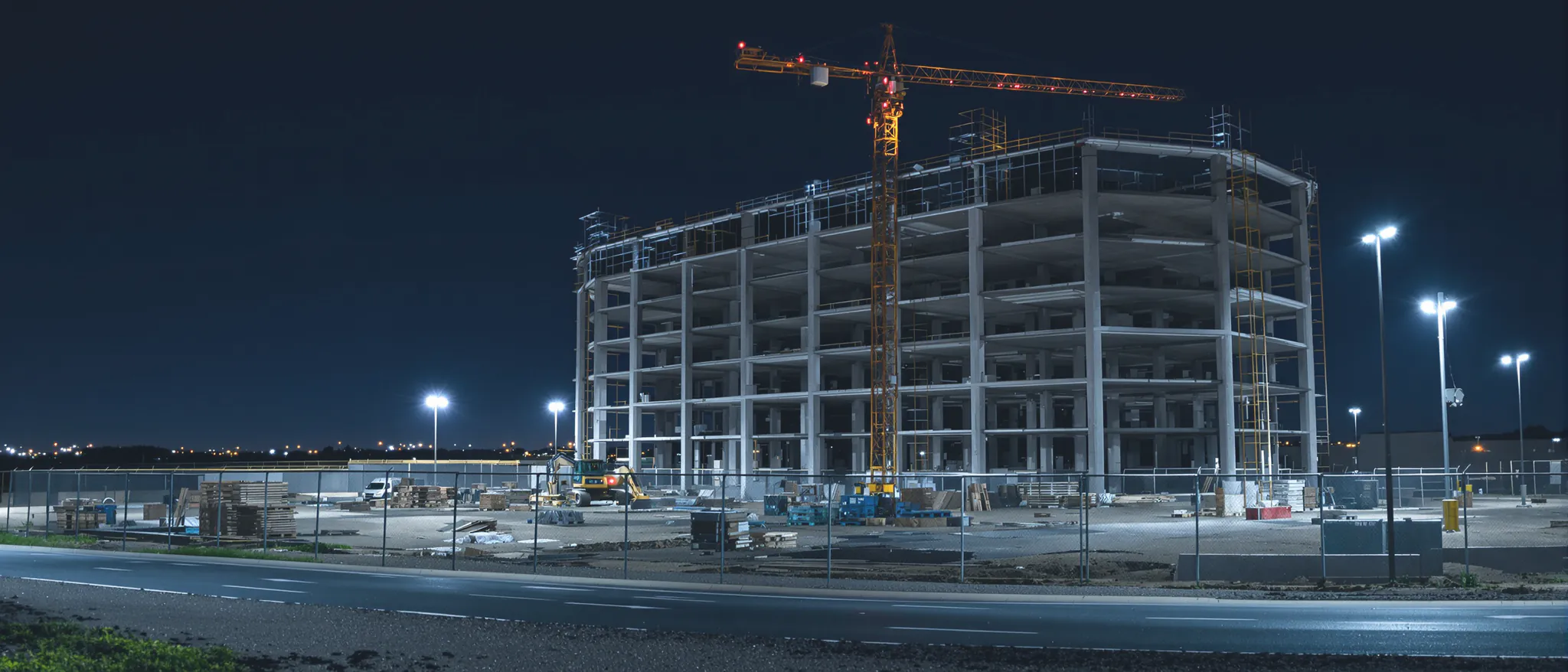
How to stop copper wire theft on a job site.
What thieves go for, where on the site they find it, and the steps that keep wire on the reel: less copper on site, locked storage, marking, light, and someone watching at night.
How do I stop copper wire theft on a construction site?
Keep as little copper on site as you can, lock what stays in a container or closed-in building, mark every reel and length of pipe with your company name, and light the storage areas. Then have the site watched overnight: wire theft is usually found the next morning, so what stops it is someone seeing it and acting while it happens.
Watched after the last crew leaves
911 Sentinel camera monitoring watches the laydown area, the container doors, and the gate through the night, from $900 a month with the leased camera, installation, maintenance, and 90 days of video included, and added cameras from $250 a month. An alert reaches our team within 30 seconds, and within 3 minutes an operator warns the person off through the camera with a recorded voice, siren, and spotlights, then calls your team and the police.
For long fence lines, drive-by vehicle patrol from $1,500 a month runs our camera vehicle past the site on a schedule, and on-site vehicle patrol from $2,200 a month keeps it parked on the site through the window. One unarmed guard 8 hours a night in Seattle costs about $9,380 a month at the state contract median.
What gets stolen, and from where?
The risk peaks between delivery and install: reels sit in the open, and new wire is pulled before the building can be locked at night.
| What gets stolen | Where on the site | What covers it |
|---|---|---|
| Wire on reels and coils | Laydown areas, open staging, beside the site trailer | A locked container, a light, and a camera on the doors |
| Pulled wire in conduit | Unfinished floors and electrical rooms after rough-in | Lock the building at night; cameras on the doors and stairs |
| Copper pipe and tubing | Mechanical rooms and plumbing staging | Deliver close to install; container storage |
| Temporary power cable | Runs to the trailer, light towers, and pumps | Coil it at night where you can; a light and a camera on the run |
Make it hard to take
- Schedule wire deliveries close to when it will be pulled, and keep the rest off site.
- Store reels in a locked container with a shrouded lock, parked where a light and a camera can see the doors.
- Once wire is pulled, close in and lock the building at night, including stairs and hoist landings.
- Light the laydown area, the container doors, and the gate.
- Keep the gate chained, walk the fence each morning, and fix cut panels the same day.
- Clear cut-offs and scrap piles daily, so the site doesn't advertise copper.
Make it hard to sell
- Mark reels, coils, and pipe with your company name. Washington counts metal marked with the name of a commercial enterprise, and unused copper pipe, tubing, and wiring, as commercial metal property (RCW 19.290.010).
- A scrap dealer may buy commercial metal property only from a seller with a commercial account, written proof of ownership, or written proof they are authorized to sell it for the company (RCW 19.290.030).
- Every sale of nonferrous metal needs current government-issued photo ID, and a dealer may pay no more than $30 of it in cash (RCW 19.290.030).
- Deliberately removing or obliterating marks engraved or etched on metal to deceive a scrap dealer is a gross misdemeanor (RCW 9A.56.410).
- Keep photos, receipts, and reel tags for stored material, so you can prove what's yours.
Why does someone have to watch the site?
Seattle City Light's experience with streetlight wire shows the limit of hardware. Its staff told the utility's review panel in September 2025: "We have completely secured lids, vaults, tamper-proof vaults and they have still broken them," and wire theft continued "despite SCL taking measures to install tamper-proof materials."
City Light said the thefts hit "locations with lower public traffic where perpetrators have greater seclusion," and that wire theft is typically discovered after the fact. A locked, empty site at 2 a.m. is exactly that kind of place. Locks slow a thief down; someone watching gets a warning out and the police called while the person is still there.
What should you do when wire goes missing?
- Report it to police that day, with your marks, serial numbers, photos, and the night's video. After written notice from police that metal was reported stolen, a scrap dealer must hold it for up to ten business days (RCW 19.290.060).
- Count the full cost of the damage, not just the wire: pulled conduit, broken boxes, and repairs. Washington grades metal theft by that cost: over $750 is a class C felony, over $5,000 a class B felony (RCW 9A.56.040, RCW 9A.56.030).
- Check the rest of the site for cut fence panels or forced doors before the next night.
- If you see a wire theft in progress, call 911, as WSDOT advises.
Common questions
What is the best way to stop copper theft on a job site?
Keep little copper on site, lock what stays in a container where a light and a camera can see it, mark it with your company name, and have the site watched at night, so a person is warned off and the police are called while they're still there.
Does marking copper wire help stop theft?
Mark every reel, coil, and length of pipe with your company name. Washington treats metal marked with a company's name as commercial metal property, which a scrap dealer may buy only from a seller with a commercial account, written proof of ownership, or written authorization to sell it.
What should I do after copper wire is stolen from my site?
Report it to police the same day with your marks, serial numbers, photos, and any video. Written notice from police makes a scrap dealer hold the reported metal for up to ten business days.
How much does it cost to have a job site watched overnight?
911 Sentinel camera monitoring starts at $900/mo for one leased camera with an 8-hour nightly window, and added cameras start at $250/mo, so a three-camera site starts at $1,400/mo. An operator warns intruders through the camera within 3 minutes of an alert, then calls your team and the police.
Sources
Checked .
- RCW 19.290.010, definitions (commercial metal property)
- RCW 19.290.030, ID, commercial metal, and payment rules
- RCW 19.290.060, holding stolen metal property
- RCW 9A.56.410, metal property deception
- RCW 9A.56.040, theft in the second degree
- RCW 9A.56.030, theft in the first degree
- Seattle City Light Review Panel, meeting notes, September 17, 2025
- WSDOT, report material theft
- Washington DES statewide contract 00624, Security Guard Services (contract summary)
- Contract 00624 price sheet, effective August 1, 2026, updated September 25, 2026
Get a free site assessment
We reply the same day, walk your property with you, and send a written plan with a firm price after the walk.
Business calls 8am–8pm every day · our monitoring team works around the clock