
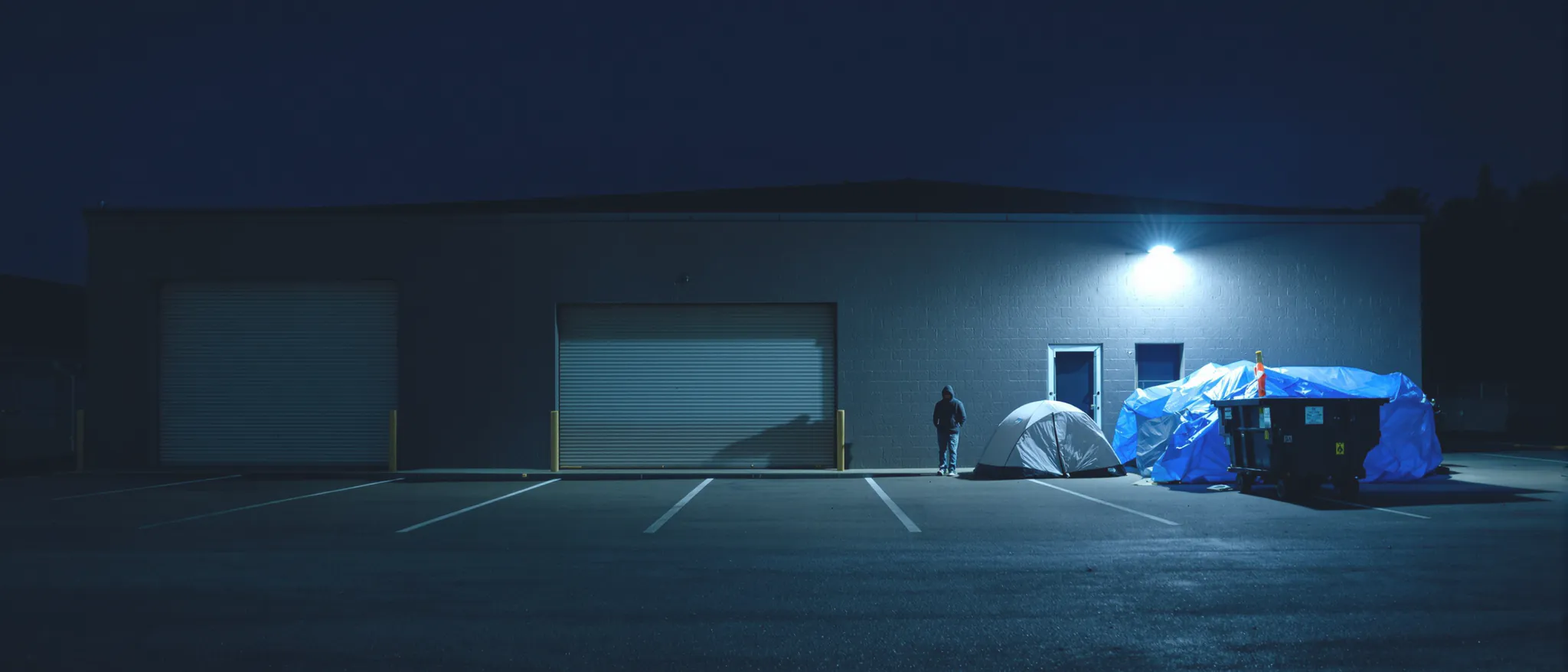
Someone is camping on your property.
What a Seattle-area owner can do about a person sleeping in the doorway or a tent on the lot: who to call, SPD's trespass program, what the city handles, and how to stop it becoming a nightly thing.
What can I do about someone camping or sleeping on my business property in Seattle?
On your own property in Seattle, you decide who stays: ask the person to leave, or call SPD's non-emergency line, 206-625-5011, and join SPD's Trespass Warning Program so officers can warn and arrest on your behalf. Tents on the sidewalk or in a park are the city's to handle through Find It, Fix It. Call 911 in an emergency and 988 for someone in crisis.
Warned off in minutes, every night
911 Sentinel camera monitoring starts at $900 a month with the leased camera, installation, maintenance, an 8-hour nightly window and 90 days of video included, and added cameras from $250 a month. An alert reaches our team within 30 seconds, and within 3 minutes an operator checks it against your site rules and plays a recorded warning through the camera with a siren and spotlights. If the person stays, we call your team, then the police if your team doesn't answer in the time you set; in an emergency we call 911 right away.
Every night is on video and in a timestamped report, which is the record SPD's trespass program and the city's teams work from. See how it works on a lot with people camping or the pricing.
Is it your property or the sidewalk?
The first question decides who acts. Seattle's encampment rules, now FAS rule UE-01, cover city property: sidewalks, rights of way and parks. Your lot, your doorway alcove and your loading dock are private property, where Washington trespass law and SPD's trespass program apply.
| Where | Who acts | How to reach them | What happens |
|---|---|---|---|
| Your lot, doorway, dock or building (Seattle) | You, with Seattle Police | SPD non-emergency, 206-625-5011; 911 if anyone is in danger | Officers can warn the person; with a trespass authorization on file and signs posted, they can act for you |
| The sidewalk or street in front (Seattle) | City of Seattle Unified Care Team | The Find It, Fix It app ("Unauthorized Encampment"), or (206) 684-CITY, weekdays 8 to 5 | Obstructions of the sidewalk may be removed immediately; other sites get 72 hours' notice and removal within 7 days |
| Private property in Bellevue | You, with Bellevue Police and the city's outreach team | Police non-emergency 425-577-5656; outreach at homelessness@bellevuewa.gov or 425-452-4105 | Outreach needs your written permission to come onto the property; BPD runs its own trespass program |
| Private property in Tacoma | City of Tacoma, with Tacoma Police | Tacoma FIRST 311 (311, or 253-591-5000), "Homeless Encampment on Private Property" | The city lists an estimated 14 business days to complete the request |
Can police remove someone from my private property in Seattle?
Yes, and the trespass program makes it routine. Under SPD's Trespass Warning Program, you authorize officers to warn and, after a warning, arrest people who break your posted conditions of entry. The standard conditions are short: the property is for patrons and customers only, no law violations, and no entry after business hours without the owner's permission. Our trespass authorization guide walks through the form line by line.
- SPD's form says it "makes no warranty" about how often it enforces your conditions; that depends on officers available.
- You agree to cooperate with prosecution, which can mean someone from the property testifying.
- Vacant commercial and residential properties can join; occupied homes and apartments can't, unless they're vacant.
- Step 1
Email your precinct
Each precinct has a trespass program address (North, East, South, Southwest and West) listed on SPD's program page. A precinct officer confirms you have authority over the property.
- Step 2
Sign the authorization
SPD Form 5.34 covers one address. In a strip mall, a single business's authorization may not cover the shared parking lot, which needs its own.
- Step 3
Post the Conditions of Entry sign
SPD emails the sign. It must go up "at or near all public entrances" so the public can see the conditions.
- From then on
Officers can act for you
Officers can warn someone breaking the conditions; a later visit after that warning can mean arrest. Someone found on the property after hours who knew they weren't allowed can be arrested without a warning first. There's no renewal date: the agreement runs until either side ends it.
What Washington trespass law says about posting
Washington's trespass law, RCW 9A.52.010, turns on whether a person is "licensed, invited, or otherwise privileged" to be there. Two details matter for a commercial lot. Land that's open to the public at certain hours isn't open at other times if the closed hours are "posted in a conspicuous manner." And a fenced lot isn't "unimproved and apparently unused land," so fencing is notice by itself. Staying on premises unlawfully is second-degree criminal trespass, a misdemeanor; inside a building it's first degree, a gross misdemeanor.
One defense is worth knowing: if the premises were open to the public and the person followed every lawful condition, it isn't trespass (RCW 9A.52.090). That's why the posted conditions, and the after-hours line in them, carry the weight. More in Washington trespass law for commercial property.
Who to call, and when
- Someone hurt, a fire, or a threat: 911.
- Someone in a mental health or substance crisis: 988, which reaches the regional crisis line and King County's mobile crisis teams (or Crisis Connections at 866-427-4747).
- Someone on your property who won't leave, and no emergency: SPD's non-emergency line, 206-625-5011.
- A tent or belongings blocking the sidewalk or in a park: the Find It, Fix It app, or (206) 684-CITY.
- Seattle's CARE crisis responders work 6:30 a.m. to 1 a.m. daily, but they are "prohibited from responding independently to vehicles, private residences or businesses, or encampments with four or more tents"; at a business they come with police.
Seattle's encampment numbers
Encampment reports keep climbing faster than anything else in the city's request data. Our study of 925,306 Seattle service requests found encampment reports rose 60% over 35 months while recorded property crime stayed roughly flat, and about nine in ten requests now arrive through the city app. For your doorway, that means the city queue is long, and the fastest lever on private property is your own.
- Encampment reports to the City of Seattle in 2025, up 55% from 2024
- 76,756
- The Unified Care Team triages every request within 3 days
- 3 days
- Share of flagged sites the team inspected within 10 days
- 92%
- Notice before a non-obstructing encampment on city property is removed, within 7 days of posting
- 72 hours
What the 2024 Supreme Court ruling changed, and what it didn't
In City of Grants Pass v. Johnson, decided June 28, 2024, the Supreme Court held that enforcing general laws against camping on public property is not cruel and unusual punishment. It is about public land. Trespass on private property was enforceable before the ruling and still is.
Cities have since moved at different speeds. Tacoma's camping ban, first passed in 2022, was extended in October 2025 to 10 blocks around downtown shelters, 5 blocks around other shelters and 2 blocks around schools, parks and libraries, with a maximum $250 fine or 30 days. Bellevue prohibits camping on city property and sidewalks. Seattle works through the Unified Care Team and its encampment rule.
How to stop it becoming a nightly thing
Someone who settles into a doorway at midnight and is still there at 6 a.m. tends to come back. The window that matters is the first few minutes after they arrive, before the cardboard and the tarp go down. A warning then, with the lights on, works better than a conversation in the morning.
- Light the alcoves, docks and back corners that stay dark after close.
- Post SPD's Conditions of Entry signs with your after-hours line, and fence what you can.
- Clear what makes a spot comfortable: pallets, cardboard bales, deep recesses.
- Put a monitored camera on the spots that keep getting used, so a warning plays within minutes of someone settling in.
- Keep a timestamped record of each night: it's what SPD and the city ask for, and it's built into every alert we handle.
Common questions
What can I do about a homeless person sleeping in front of my business in Seattle?
Yes. On private property you can ask the person to leave or call Seattle Police's non-emergency line, 206-625-5011, and 911 if anyone is in danger. If you join SPD's Trespass Warning Program and post its Conditions of Entry signs, officers can warn and arrest on your behalf without you being there.
Who removes an encampment on private property in Seattle?
On private property it's the owner's call, with Seattle Police enforcing trespass. The city's Unified Care Team and the Find It, Fix It encampment category cover city parks and rights of way, not private lots. In Tacoma, the 311 system has a separate request type for an encampment on private property.
How long does Seattle take to clear an encampment on the sidewalk?
The Unified Care Team says it triages every request within 3 days and inspected 92% of flagged sites within 10 days in 2025. A tent that obstructs the sidewalk may be removed immediately; other sites on city property get at least 72 hours' notice, with removal within 7 days of the notice.
Do I need a no trespassing sign in Washington?
It depends on the property. Under RCW 9A.52.010, land open to the public at certain hours is closed at other times only if the closed hours are posted conspicuously, and unfenced, unused land needs posted or personal notice. A fenced lot is notice by itself. Seattle's trespass program requires its own Conditions of Entry sign at all public entrances.
Can a security company stop people camping on my property at night?
911 Sentinel watches the spots that keep getting used and acts within minutes: a recorded warning through the camera with a siren and spotlights, then a call to your team, then the police if your team doesn't answer in the time you set. Camera monitoring starts at $900 a month with the camera, installation and 90 days of video included.
Sources
Checked .
- Seattle Police Department, Trespass Warning Program
- SPD Form 5.34, Trespass Warning & Enforcement Authorization
- SPD Policy Manual 15.270, Trespass Warning Program (revised November 5, 2026)
- City of Seattle FAS rule UE-01, removal of unauthorized encampments (approved September 12, 2025)
- Seattle Unified Care Team, Q4 2025 report to City Council (March 24, 2026)
- City of Seattle Customer Service Bureau
- City of Seattle, Find It, Fix It app
- RCW 9A.52.010, definitions (enters or remains unlawfully)
- RCW 9A.52.080, criminal trespass in the second degree
- RCW 9A.52.090, criminal trespass defenses
- Seattle CARE Department, community crisis responders
- Seattle CARE Department, crisis responder FAQ
- Crisis Connections, 24-hour crisis line
- City of Grants Pass v. Johnson, U.S. Supreme Court (June 28, 2024)
- City of Bellevue, homelessness response information for private property owners
- City of Tacoma, encampment policies and procedures
- City of Tacoma, Tacoma FIRST 311 services
Get a free site assessment
We reply the same day, walk your property with you, and send a written plan with a firm price after the walk.
Business calls 8am-8pm every day · our monitoring team works around the clock