
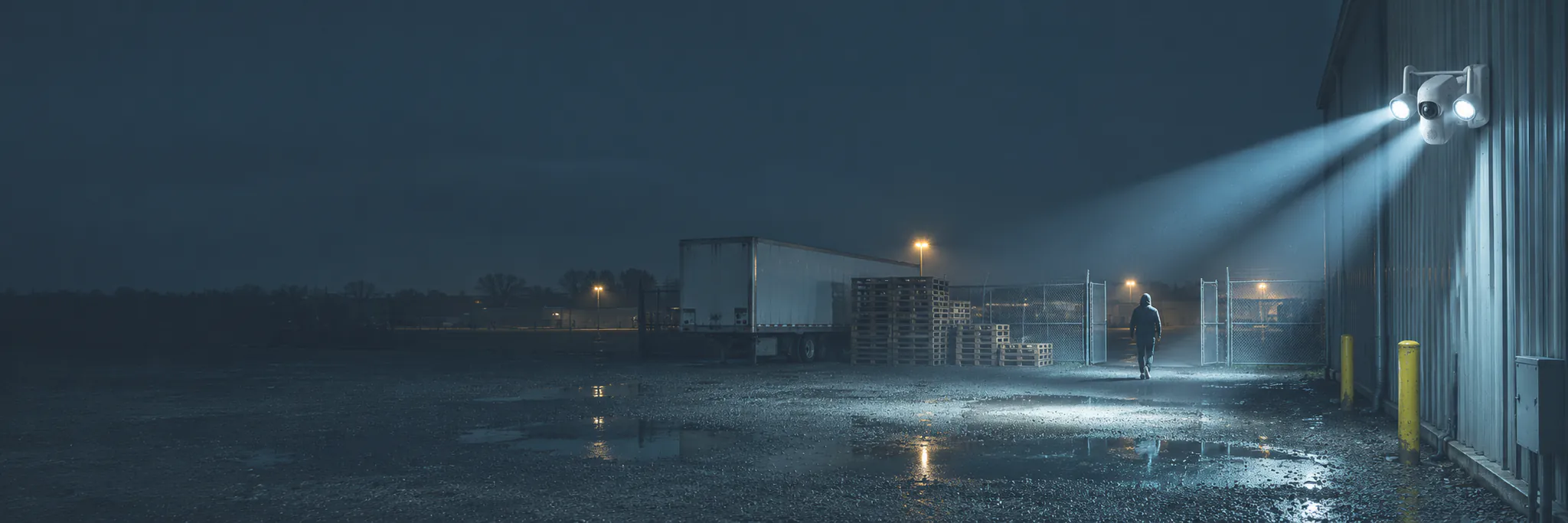
Cameras that tell trespassers to leave.
A recorded voice warning, a siren and spotlights the moment someone shows up, with a person behind every call.
What is a talk-down security camera?
A talk-down camera lets a monitoring team warn someone through a speaker on the camera while they're still at the fence or the door. At 911 Sentinel the warning is a recorded voice message with a siren and spotlights, played the moment an operator confirms an intruder, followed by a call to your team, then the police.
Warnings with a person behind them
Every camera we install carries a speaker, a siren and spotlights, and our team plays the warning the moment someone who shouldn't be there shows up. Camera monitoring starts at $900 a month with one leased camera, installation, maintenance, an 8-hour nightly window and 90 days of video, and added cameras start at $250 a month.
Every contract starts with a 30-day free trial, then runs month to month with one month's notice. See how it works, what camera monitoring includes, and whether your current cameras qualify.
The same warning moves people on from doorways and alcoves: see people sleeping in a business doorway.
We warn by voice and never record sound; Washington's security camera laws explain why that matters.
What else is talk-down called?
Voice-down, audio deterrence, live audio intervention and virtual guard warnings all name the same idea: the camera speaks to the person it sees. What separates one service from another is who decides the warning plays, and what happens after it.
| Kind | Who decides | What follows |
|---|---|---|
| Motion-triggered siren | The camera, on any motion: a cat, a branch, your early crew | Nothing; the camera can't tell who it scared |
| Live talk-down only | An operator, speaking through the camera | Whatever the operator has time for next |
| 911 Sentinel | AI flags a person, an operator confirms against your site rules | Recorded voice warning, siren and spotlights, then your team, then the police |
How a warning plays out on a 911 Sentinel site
- Spot
AI flags a person at the fence
Through your monitoring window, AI watches every camera and flags people and vehicles as they appear.
- Confirm
An operator checks the live picture
The alert reaches our team immediately. The operator compares it with your site rules, so your crew never hears a warning meant for a trespasser.
- Warn
The warning plays
A recorded voice message tells them they're on camera and to leave, with a siren and spotlights on the spot where they stand.
- Call
Your team, then the police
If they stay, we call the contacts you gave us, then the police if nobody answers in the time you agreed; in an emergency, 911 right away.
- Record
The night goes on the record
Every warning and call lands in an incident report with the video.
Why warn instead of just recording?
A recording shows you in the morning what was taken. A warning acts while the person is still at the fence, before they reach the materials, the door or the trailer. The spotlights put them in the middle of the picture, the siren tells everyone nearby, and the voice message tells them exactly what happens next.
It's the first step of a sequence, not the whole plan: if they stay, our team is already on the phone to your team and then the police. For a property that keeps getting the same visitors, see how to stop repeat trespass.
Does a talk-down camera record sound?
Ours never do. 911 Sentinel records video only, kept 90 days, and the speaker only plays warnings. Washington is strict about audio: RCW 9.73.030 makes it unlawful to record a private conversation "without first obtaining the consent of all the persons engaged in the conversation." Video-only cameras keep conversations on your property off the record entirely.
Where should talk-down cameras go?
Where a person decides whether to keep going:
- Vehicle and pedestrian gates
- Fence lines that face a road or a trail
- Back doors and loading docks
- Materials staging and tool containers
- Dumpster enclosures and side yards
- Recessed doorways and building corners
What happens if they don't leave?
We call your team, then the police if nobody answers in the time you agreed, and 911 right away in an emergency. The call tells police what the camera shows as it happens, which is the kind of evidence Seattle police name when they decide which alarm calls to answer (police and alarms in Seattle). Compare that with a plain burglar alarm.
Common questions
What is a talk-down camera?
A talk-down camera has a speaker a monitoring team uses to warn someone on your property while they're still at the fence or the door. 911 Sentinel plays a recorded voice warning with a siren and spotlights the moment an operator confirms an intruder, then calls your team, then the police.
Is the talk-down warning live or recorded?
911 Sentinel plays a recorded voice warning, triggered by an operator who has checked the live picture against your site rules. The siren and spotlights go with it, and the operator moves straight on to calling your team and, if needed, the police.
Do talk-down cameras record audio?
911 Sentinel cameras record video only, never sound, and keep it for 90 days. The speaker plays warnings; conversations on your property are never recorded.
What happens after the warning if the person stays?
We call the contacts you gave us, then the police if nobody answers in the time you agreed, and 911 right away in an emergency. Every warning and call goes into an incident report with the video.
How much does talk-down camera monitoring cost?
Camera monitoring starts at $900 a month with one leased camera with a speaker, siren and spotlights, installation, maintenance, an 8-hour nightly window and 90 days of video. Added cameras start at $250 a month, and there are no per-call fees.
Sources
Get a free site assessment
We reply the same day, walk your property with you, and send a written plan with a firm price after the walk.
Business calls 8am-8pm every day · our monitoring team works around the clock