
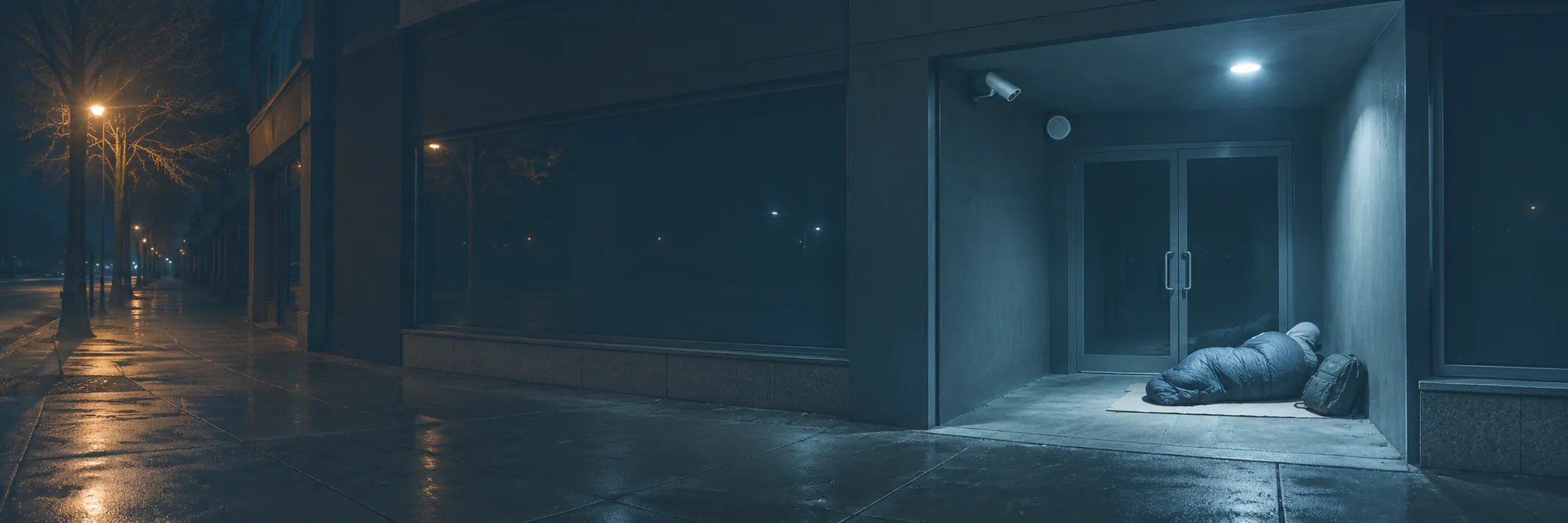
Someone keeps sleeping in your doorway.
Why recessed shop entries draw people at night, what Washington law says once you close, and the changes that keep the alcove empty, night after night.
How do I stop people sleeping in my business doorway?
Have the doorway watched and make it a place nobody can settle into. A monitored camera warns anyone who sets up in the alcove before they settle in. Once you close, your entry is no longer open to the public: in Seattle, enroll in SPD's Trespass Warning Program and post its Conditions of Entry sign, light the alcove brightly and clear ledges and cover.
Your doorway, watched from closing to opening
911 Sentinel camera monitoring starts at $900 a month with the leased camera, installation, maintenance, an 8-hour nightly window and 90 days of video included, and added cameras start at $250 a month. An alert reaches our team immediately. An operator checks it against your site rules and plays a recorded warning through the camera with a siren and spotlights. If the person stays, we call your team, then the police if your team doesn't answer in the time you set; in an emergency we call 911 right away.
Shops, restaurants and offices with street-level entries use the same setup; see retail security for the full picture, or see the pricing. Every contract starts with a 30-day free trial.
Restaurants see this at back doors and patios too: see restaurant and bar security, and how a talk-down warning works.
When to call 911 and when to use the non-emergency line: how to report trespassing in Seattle.
Why do people sleep in store doorways?
A recessed shop entry is the most sheltered spot on most commercial blocks: out of the rain and wind, a dry floor, a wall on three sides and a locked door at the back. Between closing and opening nobody is there to notice. Take those things away and the doorway stops being the obvious place to spend the night.
- A deep alcove out of the rain and wind.
- A dry, flat floor and a step or ledge to sit on.
- No light once the sign goes off.
- Eight or more hours with nobody watching.
- No posted conditions of entry.
- Last night's cardboard or bedding still in place.
Is my doorway open to the public after closing?
No. Washington's trespass law turns on whether the premises are open to the public at the time. Under RCW 9A.52.080, knowingly entering or staying on the premises of another without lawful authority is criminal trespass in the second degree, a misdemeanor. The defense in RCW 9A.52.090 covers someone only while the premises are "open to members of the public" and they follow the lawful conditions on being there.
So the same alcove reads two ways. During business hours it's part of an open shop. After you lock up, it's private property that isn't open, and a posted condition of entry makes that plain to everyone. The Washington trespass law guide walks through the whole of RCW 9A.52, and the encampment guide covers tents on a lot and what the city handles on the sidewalk.
- Staying on another's premises without lawful authority (RCW 9A.52.080)
- Misdemeanor
- The trespass defense for premises open to the public (RCW 9A.52.090)
- Only while open
- SPD's Trespass Warning Program covers open businesses and vacant property
- All hours
How Seattle's Trespass Warning Program works for a doorway
SPD's Trespass Warning Program is an agreement between an owner and the department that sets the conditions of entry for the property. It lets officers "contact, warn, and / or arrest individuals on behalf of the property owners" at all hours, for open businesses and vacant buildings alike. A person is warned that their privilege to stay is revoked before any arrest, and owners agree to cooperate if a case is charged.
Signing up takes three steps, and the Seattle trespass program guide covers each form in detail. Track how often trespass calls come in near you on our Seattle trespass report.
- Step 1
Email your precinct
Each of SPD's five precincts runs its own program inbox and sends the trespass authorization form by email.
- Step 2
Receive your sign
After you apply, SPD sends a PDF of the "Conditions of Entry" sign for your property.
- Step 3
Post it where it's seen
Put the sign in a clear spot at the doorway. Posting is what lets officers act on your behalf when you're not there.
What keeps a doorway empty at night?
Light, a closed-off alcove and someone watching do the work. Seattle's Storefront Security Fund reimburses up to $10,000 per business for several of these after a free crime prevention (CPTED) assessment, and only purchases made after that assessment count. It pays for equipment, not for anyone to watch it.
| Change | What it does | Seattle Storefront Security Fund |
|---|---|---|
| Bright light on a timer or motion sensor | Takes away the dark corner people choose | Lighting is an eligible expense |
| A scissor or folding gate across the alcove | Closes the space itself after hours | Scissor gates and window folding gates are eligible; get any permit first |
| Clear ledges, steps and planters people tuck behind | Leaves nothing to lean on or hide behind | Defensive landscaping near access points is eligible |
| Clear cardboard and bedding every morning | Removes the sign that the spot is taken | Not a fund item |
| A camera with a speaker and spotlight on the alcove | Lets someone warn a person as they set up | Cameras are eligible as equipment; monitoring services are not |
Why the first hour decides it
A doorway becomes a nightly spot when someone settles in once and nobody disturbs them. The warning works best before the sleeping bag comes out. That's the moment a recorder misses and a monitored camera catches: someone stops in the alcove after close, and a person on our team sees it right then.
Doorways are part of a wider pattern of repeat trespass: the same spot draws the same use until something changes there. If the glass itself is the target, see stopping smash-and-grab break-ins.
- Closing
Coverage starts
The monitoring window opens when you lock up, with the alcove, the windows and the door in view.
- Someone stops
Our team sees it
AI flags a person stopping in the doorway, and the alert reaches our team immediately.
- Right away
A recorded warning
An operator plays a recorded warning through the camera's speaker, with a siren and the spotlight on the alcove.
- If they stay
Your team, then police
We call your team, then the police if your team doesn't answer in the time you set. Enrolled in SPD's program, officers can act for you.
- Morning
A report with the clip
You get an incident report with the time, the clip and every call we made.
How do I clean up needles left in my doorway?
Plan for it. Public Health – Seattle & King County says sharps found on private property are the property owner's responsibility, and it gives a short method for picking them up safely.
- Wear thick, puncture-resistant gloves.
- Pick it up with tongs or pliers, never your hands.
- Drop it needle-down into a sharps container or thick plastic bottle.
- Don't recap, bend or break the needle.
- Seal it, label it "SHARPS, DO NOT RECYCLE", keep it under 2 liters.
- Never put it in recycling; businesses use the business disposal options.
Common questions
Can I make someone leave my business doorway at night?
Yes. Once you're closed, your doorway is private property that isn't open to the public, so you can ask the person to leave, and staying after that is criminal trespass in the second degree under RCW 9A.52.080. In Seattle, enrolling in SPD's Trespass Warning Program and posting its Conditions of Entry sign lets officers warn and arrest on your behalf.
Do I need a sign to keep people out of my store entrance in Seattle?
For SPD to act on your behalf, yes. Owners in the Trespass Warning Program sign an agreement with their precinct, receive a PDF of the Conditions of Entry sign and post it in a clear location. Officers then warn a person that their privilege to stay is revoked before any arrest.
Who cleans up needles left in my doorway?
You do. Public Health – Seattle & King County says sharps found on private property are the owner's responsibility. Use thick gloves and tongs or pliers, drop the needle point-down into a sharps container or thick plastic bottle, seal and label it, and never put it in recycling.
Does a monitored camera keep people out of a doorway?
It moves them on before they settle in. 911 Sentinel watches the alcove from closing to opening: when someone stops there, our team sees it immediately, plays a recorded warning with a siren and spotlight, then calls your team and the police if your team doesn't answer in the time you set.
What does it cost to have my doorway watched at night?
911 Sentinel camera monitoring starts at $900 a month with the leased camera, installation, maintenance, an 8-hour nightly window and 90 days of video included. Added cameras start at $250 a month, and every contract starts with a 30-day free trial, then runs month to month.
Sources
Checked .
- RCW 9A.52.080, criminal trespass in the second degree
- RCW 9A.52.090, criminal trespass defenses
- Seattle Police Department, Criminal Trespassing (Trespass Warning Program)
- City of Seattle, Storefront Security Fund (updated November 2026)
- Public Health – Seattle & King County, how to handle used or found sharps
Get a free site assessment
We reply the same day, walk your property with you, and send a written plan with a firm price after the walk.
Business calls 8am-8pm every day · our monitoring team works around the clock